
From RNNs to Sparse Attention and Modern RAG Systems
The way machines « pay attention » has fundamentally reshaped AI. From the early days of recurrent networks to the revolutionary Transformer architecture and today’s Retrieval- Augmented Generation (RAG), attention mechanisms have evolved to help models focus on what truly matters – even in oceans of data.
1 – The Pre-Attention Era: RNNs and CNNs
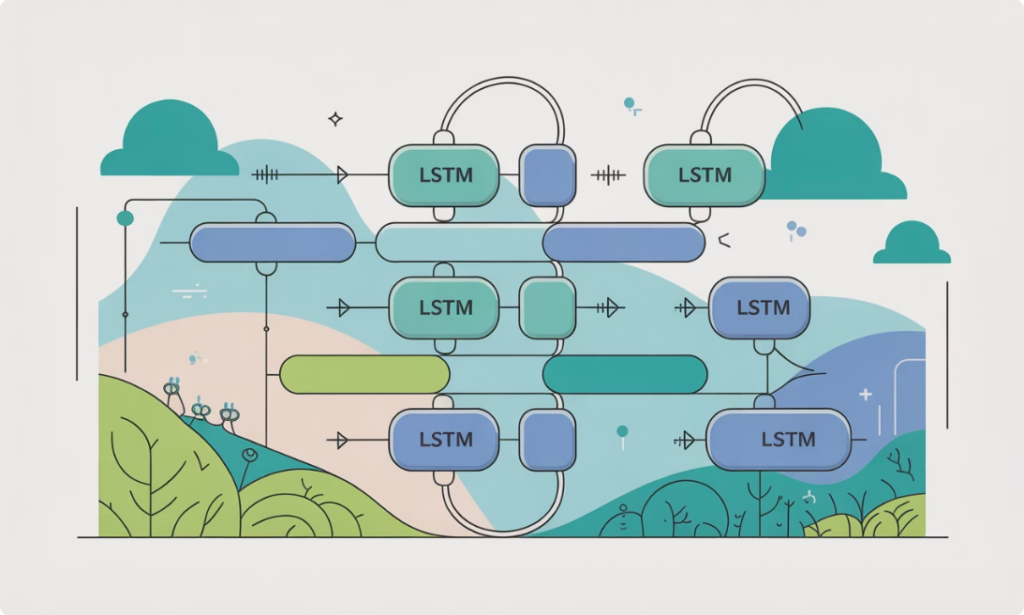
Before attention, AI relied on Recurrent Neural Networks (RNNs, LSTMs, GRUs) and Convolutional Neural Networks (CNNs):
– RNNs processed sequences step-by-step, struggling with long-range dependencies and slow training.
– CNNs excelled at local patterns but lacked global context.
– Limitation: No dynamic focus – every token was treated equally, with no way to prioritize important information.
2 – The Attention Revolution (2017: Original Transformer)

The Transformer changed everything. Introducing self-attention, it allowed
models to weigh the importance of every word in a sentence simultaneously.
This parallel processing was a breakthrough for tasks like translation and text
generation.
Strength
Global context and parallelization.
Weakness
Quadratic complexity (O(n²)) made it impractical for long sequences.
For the first time, models could implicitly focus on relevant tokens – but at a cost.
3 – The Need for Efficiency: Early Sparse Attention (2018-2019)
As models scaled, full attention became a bottleneck. Researchers explored:
Local/Block Attention
Restricting attention to fixed windows or blocks (e.g., Transformer-XL)
Hierarchical Attention
Summarizing information at different levels (e.g., word ³ sentence ³
document).
Memory-Augmented Networks
Using external memory to store compressed representations.
But these were still limited–either losing global context or requiring heuristic patterns.
Then came sparse attention

Routing Transformer (2018)
Used online k-means clustering to dynamically group and attend only to relevant
tokens, reducing complexity to O(n√n).
Sparse Transformer (2019)
Introduced fixed sparse patterns (e.g., strided, local) for tasks like image and music generation.
Impact
Models could now handle longer sequences efficiently, paving the way for scalable AI.
4 – Sparse Attention: The Game-Changer
Sparse attention wasn’t just about efficiency—it was about scalability and practicality. By selectively focusing on key tokens, models like Longformer, BigBird, and Reformer unlocked new possibilities:
- Process entire documents, codebases, or knowledge bases.
- Enable real-world applications in legal tech, healthcare, and recommendation systems.
This was the missing link for large-scale, knowledge-intensive AI.
5 – The RAG Breakthrough: Retrieval + Attention
Modern Retrieval-Augmented Generation (RAG) systems combine the best of both worlds:
Retrieve
Dynamically fetch relevant information from external knowledge bases.
Attend
Use cross-attention to integrate only the most important chunks into responses.
Result: More accurate, up-to-date, and context-aware outputs
Result: More accurate, up-to-date, and context-aware outputs—ideal for chatbots, search engines, and enterprise AI.
RAG doesn’t just generate answers; it reasons with precision, pulling from vast repositories in real time.
6 – The Future: Hybrid and Adaptive Attention
The next frontier? Hybrid attention models that blend:
Learned sparsity
(e.g., LSH, clustering)
Retrieval mechanisms
(e.g., dense/sparse retrieval)
Adaptive focus
for dynamic, efficient reasoning
For tech professionals, this means faster, smarter, and more adaptable AI—whether you’re building search engines, chatbots, or data pipelines.